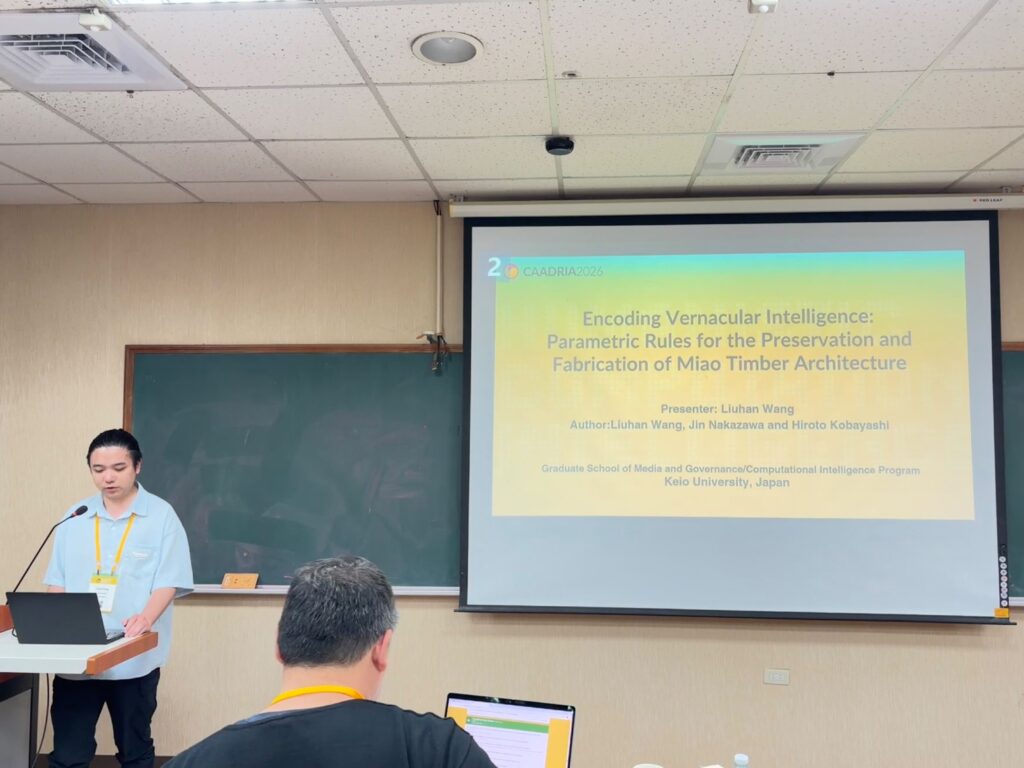
博士課程2年 王君の論文が台湾・新竹の國立陽明交通大学で開催されたCAADRIA2026に採択され,発表しました.
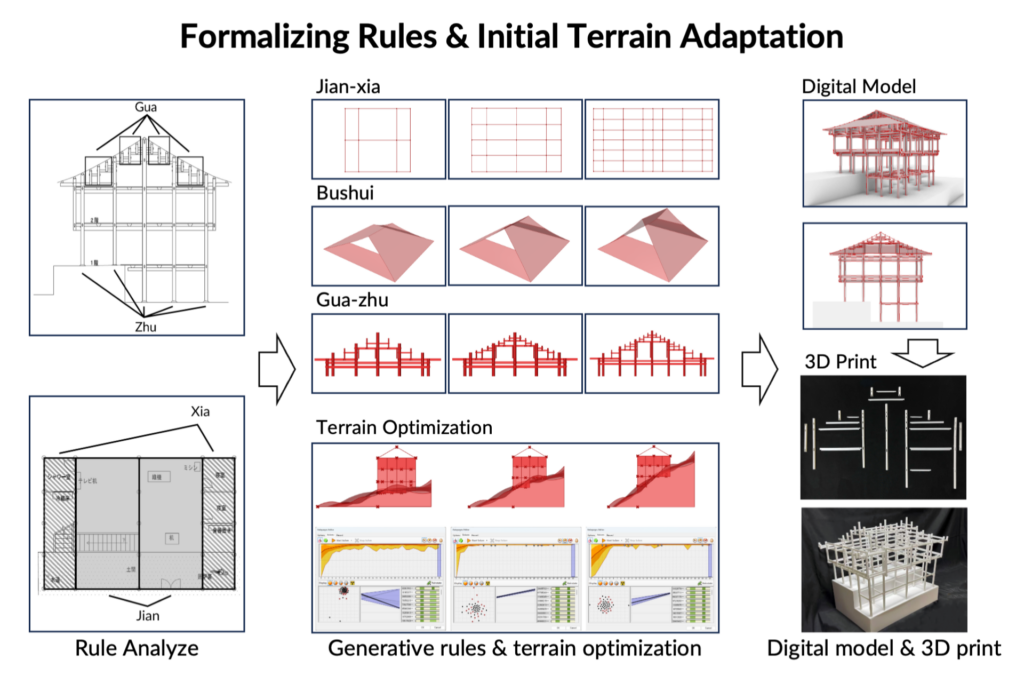
Abstract: Timber dwellings of the Miao people in Southwest China embody orally transmitted construction intelligence developed by Zhangmoshi master carpenters. While photogrammetry and laser scanning can capture geometry, they reveal little of the proportional and procedural logic guiding construction. This study proposes a rule-based parametric framework that encodes key Miao principles—Jian-xia (bay layout), Gua-zhu (bracket–column relation), and Bushui (roof slope)—using Grasshopper and Python. The system integrates terrain optimisation via Galapagos and is structured for interoperability with Heritage BIM environments. Validation on a representative Miao dwelling demonstrates geometric fidelity and adaptability. Through modular rule extraction and parametric recombination, the framework enables systematic variation while preserving vernacular coherence. The resulting system supports reconstruction, analytical comparison, and design exploration across different site conditions and parameter settings. By translating oral craft knowledge into computational rules, the research advances digital heritage and contributes to broader discussions of cultural algorithmicity and computational heritage in vernacular architecture. The approach further suggests a transferable methodology for encoding other tectonic timber traditions facing challenges of intangible knowledge loss.
Wang, Liuhan, Jin Nakazawa, and Hiroto Kobayashi. “Encoding Vernacular Intelligence: Parametric Rules for the Preservation and Fabrication of Miao Timber Architecture.” (2026).